![[slide:title]](/static/upload/other/20260512/1778551853592214.webp)
![[slide:title]](/static/upload/other/20260512/1778551954982306.webp)
Time:2026-09-28 Form:本站
In the procurement of dental implant supply chains, dental laboratory manufacturing and clinical restoration scenarios, the vast majority of distributors and dental technicians confuse two core concepts: OEM implant restorative components and stock standard prefabricated parts. Many mistakenly believe they only differ in naming and have consistent quality. In fact, they feature fundamental disparities in design logic, processing standards, fitting precision, customization flexibility, cost structure and clinical application scope.
Simply put, stock parts are prefabricated finished products with fixed specifications for universal adaptation. OEM components are precision processed parts replicated according to brand drawings and customized to customer requirements with parameters benchmarked against original manufacturer standards. Against the backdrop of mixed use of multiple implant systems and popularized digital restoration, accurately distinguishing their differences and matching corresponding clinical and stocking scenarios is the core key for dental suppliers, chain clinics and dental laboratories to control after-sales risks, optimize inventory and boost profits. This article delivers comprehensive and practical professional analysis from six dimensions: definition, core distinctions, advantages & disadvantages, applicable scenarios, selection strategies and common misunderstandings.
OEM stands for Original Equipment Manufacturing. Dental implant OEM restorative components refer to restoration parts independently produced by professional precision factories in strict accordance with the original drawings, interface parameters, tolerance standards and version iteration data of mainstream implant brands. The full range includes abutments, healing abutments, transfer copings, implant analogs, restoration screws, scan bodies and more. These products are not labeled with the original brand. Professional medical device factories undertake production, quality inspection and quality control. Process, packaging and parameter adaptation scope can be fine-tuned upon customer requests to support customized adjustments. They feature original-benchmarked precision, multi-system compatibility and high precision. Manufacturers represented by RE-TECH continuously track version iterations of major brand systems and update processing parameters and digital databases synchronously to guarantee fitting accuracy and batch stability of OEM components.
Stock parts, also known as prefabricated standard parts or universal stock components, are mass-produced universal accessories with unified industry specifications and fixed dimensions. They are not deeply replicated for exclusive interfaces of a single brand. Instead, they are manufactured based on conventional universal dimensions, tapers and thread specifications in the industry. With fixed sizes and no personalized customization or version classification, stock parts are characterized by universal applicability, mass production, low unit price and sufficient stock. They fit most conventional general implant structures on the market without refined version differentiation, featuring low adaptation thresholds. Nevertheless, they cannot match special iterative models and high-precision restoration requirements.
Many clinical rework and fitting failures, as well as inventory waste, stem from inappropriate component selection. The following clarifies the gaps between the two from six core dimensions: interface fitting & precision, version iteration identification, customization capability, quality control system, cost structure and after-sales risk.
OEM Components: Manufactured with micron-level tolerances benchmarking original manufacturers. They fully replicate the taper, anti-rotational groove depth, platform diameter, thread pitch and limit height of target implant systems. Old and new version parameters are strictly differentiated for passive seating without play or micro-movement after assembly. The sealing meets standards to fully satisfy precision requirements for permanent restoration, and mechanical performance complies with original clinical benchmarks.
Stock Parts: Adopt average universal industry parameters without precise calibration for individual brands or versions, with looser tolerance ranges. They only adapt to conventional general interfaces. For implant systems with revised brand iterations, special tapers or special limiting structures, seating gaps, rocking and poor bonding tend to occur, and the precision fails to support high-demand permanent restoration.
The core advantage of OEM components lies in version and series-specific adaptation. For iterations of old and new systems from various brands, independent filing, separate mold opening and parameter calibration are implemented to precisely identify interface differences between old and new models and prevent failure caused by cross-version mixed use, delivering strong adaptation stability.
Stock parts have no version or series classification and adopt unified universal parameters by default for cross-brand application. When facing newly launched implants with slightly revised brand interfaces, precise adaptation is hardly achievable, which may easily trigger fitting jamming, insufficient screw tightening, marginal leakage and other hidden risks.
OEM components support full-dimensional customized adjustments. Surface treatment, screw hardness, abutment height, angle and packaging style can be modified according to customer demands. Supporting exclusive digital scanning databases can also be updated to adapt to personalized clinical and digital restoration requirements with flexible applicable scenarios.
Stock parts feature fixed specifications, processes and dimensions with no customization available. All products are uniformly mass-produced and merely meet basic conventional restoration demands, unable to adapt to personalized and complex cases.
OEM Components: Formal OEM factories implement full-process medical-grade quality control, including raw material sampling inspection, first article inspection, 3-coordinate dimension verification, torque fatigue testing and batch sample retention testing. Data of each batch is traceable with minimal batch deviation to ensure long-term supply quality stability and avoid mass after-sales issues.
Stock Parts: Focus on mass production for cost reduction with simplified QC procedures dominated by appearance inspection, lacking precision dimension and mechanical property testing. Batch dimensions are prone to drift, resulting in inconsistent performance where the same model works well in one batch but presents adaptation anomalies in another.
OEM components incur higher upfront costs for R&D, drawing benchmarking, equipment commissioning and precision quality inspection. Their unit price is higher than ordinary stock parts yet far lower than original manufacturer accessories, delivering outstanding cost performance as high-precision products with moderate costs.
Stock parts enjoy large-scale mass production, simple processes and no R&D iteration costs with extremely low unit prices and remarkable cost advantages, yet accompanied by high implicit clinical risks.
OEM components feature controllable risks. After complete practical verification, they deliver precise adaptation and strong stability with rare complications such as loosening, leakage and bone resorption, leading to low rework rates.
Stock parts carry relatively high risks. Loose micron tolerances and insufficient precision despite broad universality may trigger screw loosening, marginal microleakage, gingival inflammation and long-term bone resorption in long-term service, raising probabilities of rework and customer complaints.
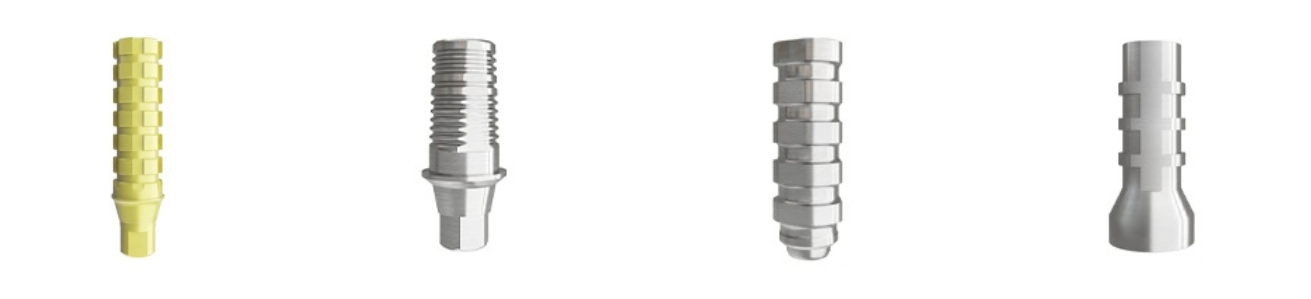
Fitting precision benchmarked against original parts for permanent restoration replacement; precise differentiation of system versions and series to eliminate cross-version adaptation failures; support for personalized customization and matching digital data; strong batch stability and low after-sales risks; streamlined SKUs to realize multi-system coverage and optimize inventory structure; procurement cost much lower than original accessories with sufficient profit margins.
Higher unit price than universal stock parts; upfront drawing R&D and sample verification required, leading to slightly longer new product launch cycles; extremely high requirements for factory machining and quality control capabilities. Poor-quality OEM products cannot guarantee quality, requiring careful screening of qualified manufacturers.
Clinical Cases: Single-tooth permanent restoration, fixed bridge restoration, high-load posterior restoration, anterior aesthetic restoration, secondary healing restoration, digital intraoral scan CAD/CAM restoration and moderately complex implant cases.
Supply Chain Stocking: Core stocking items for dental distributors, regular accessories for clinics using multiple implant systems, routine restoration materials for high-end dental laboratories, and institutions requiring after-sales risk and inventory pressure control.
Customization Needs: Brands and suppliers requiring exclusive packaging, customized processes and supporting digital databases for differentiated product layout.
Extremely low price, sufficient stock and low minimum order requirements; universal specifications compatible with most conventional basic implants; simple selection for immediate use with low procurement and operation thresholds.
No version classification and incompatibility with newly iterated implant systems
Loose precision, mediocre sealing and insufficient long-term clinical stability
Large batch fluctuations and inconsistent quality
No customization support and incompatibility with personalized complex cases
Higher risks of complications in long-term service
Clinical Cases: Provisional restoration, short-term transitional restoration, model adjustment for implant impression taking, teaching demonstration cases, low-load anterior provisional restoration and experimental testing.
Supply Chain Stocking: Emergency backup in clinics, consumables for novice technician practice, replenishment of low-cost basic consumables and basic clinics without high-precision restoration demands.
Prohibited Scenarios: Not allowed for full-mouth reconstruction, high-load posterior permanent restoration, high-end aesthetic restoration or adaptation of newly iterated implant systems.
To avoid selection confusion and accurately match requirements, apply the practical decision logic below to quickly decide between OEM and stock components.
Permanent restoration, high-load restoration or aesthetic restoration is required; high standards for rework rate and reputation are demanded; stocking accessories for multiple brands and systems simultaneously; SKU streamlining and inventory pressure reduction are needed; supporting digital intraoral scan data is required; customized product packaging and processes are needed; long-term stable supply and low after-sales risk control are pursued.
Only for provisional transition, model adjustment or teaching practice; short-term emergency use with no long-term load requirements; pursuing extreme cost reduction without high precision demands; basic adaptation for old universal implant models; consumables for novice hands-on practice.

Many practitioners assume stock parts that can be screwed in are suitable for permanent use. In reality, universal parameter adaptation inevitably leaves micron-level gaps. While abnormalities may not appear in the short run, interfacial micro-movement, bacterial leakage, screw loosening and bone resorption may occur over time, creating hidden clinical hazards.
Poor-quality OEM without proper QC is equivalent to counterfeits. However, qualified clinical-grade OEM components feature complete drawing benchmarking, precision processing, batch quality inspection and version iteration capabilities. Their precision and stability are close to original products, serving as compliant and reliable clinical restoration consumables, fundamentally different from low-grade counterfeits.
Stock parts have the lowest unit price yet incur high implicit after-sales costs, rework expenses and reputation losses. Original components deliver optimal quality with excessive premiums. Qualified OEM components balance precision, cost and stability, emerging as the primary option with the best overall cost performance currently.
Stock parts lack version classification and often fail to adapt to newly launched implants. Only version-segmented OEM components can solve adaptation challenges in mixed old and new systems, an irreplaceable core advantage of OEM over stock parts.
Q1: Can OEM components fully replace original manufacturer parts for permanent restoration?
A: Qualified and tested OEM components meet the requirements of most conventional permanent restoration in terms of precision, mechanical properties and biocompatibility and can replace original parts. Original manufacturer products are recommended as backup only for ultra-high-difficulty full-mouth reconstruction and high-risk cases with extreme aesthetic demands.
Q2: Why are stock parts not recommended for permanent restoration?
A: Stock parts feature loose tolerances, no version classification and insufficient sealing. Under long-term masticatory load, interfacial micro-movement and bacterial leakage may occur alongside screw loosening, leading to high risks of long-term complications, failing to satisfy stability requirements for permanent restoration.
Q3: What is the optimal stocking mix of OEM and stock parts for distributors?
A: Stock precise OEM components as core supplies to cover 90% of conventional clinical cases, with a small quantity of stock parts reserved for emergency use, provisional restoration and model adjustment. Build an inventory structure of "high-precision main products + low-cost auxiliary supplies".
Q4: How to distinguish high-quality OEM components from poor counterfeits?
A: Focus on three key inspection indicators: whether system versions are classified, whether batch dimension and torque test reports are available, and whether digital databases can be updated synchronously. Only manufacturers with complete QC and iteration capabilities can produce reliable OEM components.
The difference between OEM and stock implant restorative components is not merely price-based. It represents the gap between precision customized adaptation and universal mass production. Stock parts deliver ultra-low cost and convenient universality for provisional and basic teaching scenarios as low-cost auxiliary consumables. OEM components, by virtue of precise version adaptation, micron-level machining precision, stable batch quality control, customization capability and digital supporting advantages, become the primary choice for permanent restoration, routine clinical treatment and bulk stocking.
For dental implant distributors, chain clinics and dental laboratories, to balance clinical safety, after-sales risks, inventory costs and profit margins, the extensive procurement model of "only pursuing low prices" must be abandoned. A hierarchical selection logic should be established: adopt compliant OEM components for core clinical services to guarantee restoration stability, use stock parts for basic provisional scenarios to control consumable costs, and keep a small amount of original accessories as backup for high-risk cases. Such scientific combined selection can avoid clinical rework and customer complaint risks, optimize supply chain structure and lift comprehensive profitability. It constitutes the most stable and efficient operation solution for today’s dental implant supply chain.