![[slide:title]](/static/upload/other/20260512/1778551853592214.webp)
![[slide:title]](/static/upload/other/20260512/1778551954982306.webp)
Time:2026-09-16 Form:本站
After implant placement surgery in the full implant restoration workflow, the selection of restorative components directly determines whether the final prosthesis can be properly seated and maintain long-term stability. Many clinical reworks, screw loosening, and peri-implant soft tissue inflammation do not stem from the implant body itself, but from improperly selected matching restorative components. Components include healing abutments, transfer copings, implant analogs, scan bodies, central retention screws, and more. Each category of parts has corresponding verification dimensions. Component selection cannot be roughly judged by appearance or product names alone; comprehensive evaluation must be conducted from multiple dimensions including interface, material, dimension, mechanical performance, digital compatibility, and batch quality control.
Implant interfaces are divided into internal and external connections. Taper, anti-rotation grooves, and platform diameter of different brands are proprietary designs. Even if the external shape looks similar to the naked eye, minor differences in internal taper angle, groove depth, and thread specifications will create interface gaps and micromovement. Tiny interface gaps can trigger microleakage, where oral bacteria continuously infiltrate and irritate soft tissues over time, inducing peri-implant inflammation. Interface micromovement under cyclic masticatory load can also cause repeated fatigue loosening of screws. The first step in selection is to confirm the platform type compatible with the component. Implants with platform-switching design cannot directly use conventional platform components.
The same manufacturer’s implant systems undergo continuous updates to interface parameters, and geometric dimensions of interfaces are slightly adjusted between old and new versions. Many practitioners mistakenly assume that components from the same brand are universally interchangeable. Matching old-version implants with new-version components may lead to incomplete seating and insufficient locking. During selection, it is necessary to check the production batch and release version of the implant and confirm the component compatibility list. When conducting interface verification, RE-TECH separately distinguishes parameters of different iterative versions within the same system to avoid adaptation risks caused by version confusion.
In single-tooth restoration scenarios, the anti-rotation structure prevents abutment rotation. If the anti-rotation groove of the component does not match the implant, the abutment still has rotational space after tightening the screw, which eventually leads to loosening of the crown and occlusal displacement. For multi-unit bridge restorations, components without anti-rotation design can be selected in some cases, but it is also required to confirm whether the interface limiting design meets the requirements of the treatment plan.
Common clinical component materials include titanium alloy, pure titanium, zirconia, and a small number of PEEK.
Titanium alloy (Ti-6Al-4V ELI): Mostly used for central screws, healing abutments, and titanium bases. It delivers high mechanical strength and excellent fatigue resistance, suitable for posterior areas with high occlusal load.
Pure titanium: Features better plasticity, mostly used for temporary components for short-term soft tissue contouring.
Zirconia: Widely used in aesthetic restorations; it blocks metal discoloration and solves the problem of gingival dark lines in the anterior region. However, it has relatively higher brittleness and is not suitable for posterior areas with heavy occlusal force or insufficient occlusal clearance.
PEEK: Mostly applied to temporary abutments. Its elastic modulus is close to bone tissue, yet its strength is limited and it can only be used for temporary restoration.
During selection, confirm that materials comply with medical implant material standards and inspect material test reports to avoid biocompatibility risks brought by non-medical grade raw materials.
Different surface treatments affect soft tissue adaptation and corrosion resistance. The surface roughness of healing abutments influences gingival epithelial attachment; screw surface coatings (such as nitriding treatment) can reduce friction coefficients, ensure stable torque, and resist thread stripping after repeated assembly and disassembly. Poor surface treatment may lead to metal ion precipitation and thread wear, shortening component service life.
Components are exposed to saliva for a long time and require good corrosion resistance. Unqualified alloy composition or defective surface treatment can cause corrosion over time, resulting in metal ion release and surface pitting, which induces gingival discoloration and local irritation.
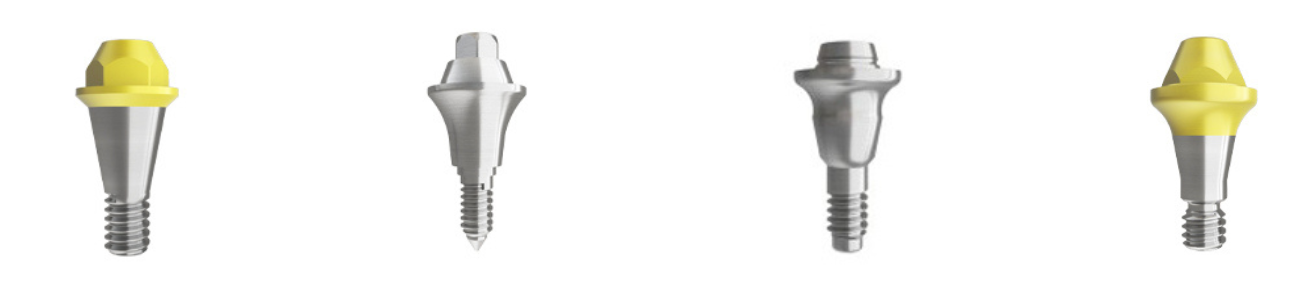
The platform diameter of the component must match the implant platform, while reserving safe clearance from adjacent teeth and neighboring implants. An overly large diameter compresses gingiva and causes bone resorption; an excessively small diameter leads to insufficient strength at the restoration margin and frequent porcelain fracture. For multiple consecutive implants, the soft tissue space between adjacent components also needs to be assessed.
The gingival height is selected according to the patient’s gingival thickness. If the gingival height is too low, the component is buried under the gingiva, increasing the difficulty of impression taking and scanning, and may also cause excessive soft tissue hyperplasia. If the gingival height is too high, excessive metal margins are exposed, compromising aesthetic outcomes and facilitating plaque accumulation. The selection of abutment height during the healing phase directly determines the contour of gingival shaping and affects the final restoration margin position.
Angled abutments are used to correct deviation in implant placement angle. It is necessary to evaluate the tilt angle of the implant and select the corresponding angled abutment. Improper angle selection will cause occlusal interference of the prosthesis and excessive lateral force, accelerating screw fatigue and bone resorption.
The thread pitch and thread diameter of central screws must be fully matched. Forcibly screwing in mismatched threads will directly damage the internal threads of the implant and render the implant unusable, which counts as a serious clinical incident.
The central screw is the mechanically weak point. Attention should be paid to the ultimate breaking torque and torque attenuation after repeated assembly and disassembly. In clinical operations, screws need to be tightened and removed repeatedly. If torque drops rapidly after multiple uses, screw loosening or even fracture may easily occur. Posterior regions bear heavy occlusal load and have higher requirements for screw fatigue strength.
Each component has a standard tightening torque calibrated by the manufacturer. Confirm the recommended torque value during selection. Excessive torque may cause thread stripping and thread damage; insufficient torque easily leads to loosening under masticatory load.
Abutments and bases need to meet occlusal loading requirements. For zirconia abutments, the fracture load test results should be prioritized. Zirconia components with low strength cannot be selected for cases with insufficient occlusal clearance or heavy bite force.
Under digital workflows, scan bodies must precisely match the implant interface and be equipped with corresponding standard CAD databases. If scan body data is inaccurate, deviations will occur in intraoral scanning data, and crowns designed via CAD and milled cannot be seated afterwards. During selection, confirm that stable digital library files are available and compatible with mainstream intraoral scanners and design software.
For some components, physical processing parameters deviate from digital library data. The physical part can be seated normally, but the prosthesis fabricated according to the digital model cannot be installed. High-quality components implement unified verification of machining tolerances for physical parts and digital models to guarantee stable performance for both conventional impression and digital scanning workflows.

Implant components are precision parts; micron-level tolerances can affect marginal fit. Tolerance ranges of interfaces, threads and platform positions are core indicators for evaluating component quality. Excessive tolerance results in gaps and wobble during seating; insufficient tolerance causes jamming and incomplete seating.
Dimensional fluctuation between different production batches is a frequently overlooked risk. For components of the same model, smooth seating in one batch and jamming in the next will bring persistent troubles to clinics and dental laboratories. Stable production quality control keeps dimensional differences between batches within an extremely small range.
During selection, assess component lead time and the risk of product discontinuation. If components are discontinued, patients will encounter difficulties in follow-up visits, maintenance and part replacement, and may even need removal of the original restoration for remake. For patients requiring long-term follow-up, supply chain sustainability is a non-negligible indicator.
| Evaluation Dimension | OEM Components | Fully Validated Compatible Components |
| Interface & Version Matching | Developed as an integrated system with fully compliant parameters | Compatibility list needs review, version range confirmation and advance sample testing |
| Mechanical & Fatigue Data | Sufficient long-term clinical follow-up data available | Supported by manufacturer’s lab test reports; premium products can reach equivalent standards |
| Digital Database | Complete support and continuous updates | Premium suppliers maintain scanning data synchronously; data for some niche systems is missing |
| SKU & Inventory | Numerous models with heavy inventory pressure | Streamlined SKU covering multiple systems and lower stocking burden |
| Applicable Scenarios | Complex aesthetic cases, full-arch reconstruction, high-risk treatments | Routine single-tooth restorations, simple bridges, secondary impression taking, temporary restorations |
Verify the implant brand, platform and production version to filter the corresponding compatible component list; do not judge merely by appearance.
Determine diameter, gingival height and angle according to intraoral soft tissue thickness, implant position and occlusal load.
Confirm material type; assess light transmission for anterior aesthetic cases and prioritize mechanical strength for posterior areas.
Conduct seating tests and torque tests at the sample stage. Add scanning verification for digital workflows.
Inspect material certificates and mechanical test reports to confirm the supplier’s batch quality control capability.
Evaluate supply stability and confirm follow-up replenishment and long-term after-sales support.
Q1: If two components look identical, can they be used interchangeably?
A: No. External contour is only a reference. Hidden parameters such as internal taper, anti-rotation grooves and threads cannot be distinguished visually. Even if the screw can be tightened, tiny gaps may exist, causing micromovement and microleakage over time and leading to long-term complications. The model and version must be checked against the compatibility list.
Q2: For anterior aesthetic restoration, should zirconia abutment or titanium abutment be prioritized?
A: Zirconia abutment is preferred for anterior aesthetic restoration to avoid gingival dark discoloration caused by metal transmittance. However, if occlusal force is heavy and occlusal space is insufficient, the risk of zirconia fracture increases. A composite solution of titanium base plus zirconia superstructure can be adopted to balance strength and aesthetics.
Q3: Are machining tolerances of compatible components generally inferior to OEM parts?
A: Not necessarily. Quality differences depend on the manufacturer’s processing equipment and quality control standards, rather than the distinction between OEM and compatible products. Some compatible component manufacturers adopt high-precision 5-axis machining with strict tolerance control. Nevertheless, sample measurement to verify seating, marginal fit and torque stability is required before procurement.
Q4: What are common pitfalls in scan body selection?
A: The most common issue is inconsistency between digital models and physical parameters. Scan bodies have insufficient machining accuracy, or the supporting database is not updated in line with versions. Prostheses designed after intraoral scanning cannot be seated. It is recommended to perform scanning tests before procurement to verify data consistency.
Q5: What are key points for replacing components during follow-up visits of the same patient?
A: First, confirm the brand, platform and version of the original implant. Do not directly select new-version components with the same name. Second, check screw specifications and prefer retention screws of the same model. After replacement, tighten to the recommended torque and recheck occlusion and marginal fit.
Selecting implant restorative components is a refined evaluation task and cannot rely merely on product names or appearance. Interface parameters, version iteration, material mechanical performance, dimensional adaptation, digital compatibility and batch stability collectively determine the short-term seating outcome and long-term clinical performance of restorations. OEM components deliver stable matching for corresponding systems but bring heavy inventory pressure for multi-system stocking. Fully tested compatible components can simplify the supply chain, yet sample verification and clarification of adaptation scope are prerequisites. Establishing standardized verification and sample testing procedures can reduce clinical rework, lower long-term complications of implant restorations and guarantee lasting stability of restorations.