![[slide:title]](/static/upload/other/20260512/1778551853592214.webp)
![[slide:title]](/static/upload/other/20260512/1778551954982306.webp)
Time:2026-10-16 Form:本站
Within dental implant restoration systems, the abutment acts as the critical connector linking the endosseous implant fixture to the final crown. It undertakes key functions including occlusal force transmission, soft tissue sealing and retention of the prosthetic restoration. Many clinics and procurement teams hold a common misconception: if the abutment interface matches, it fits all clinical cases. However, long‑term clinical data demonstrates that abutment type, material, contour and mechanical strength directly govern prosthetic service life, gingival esthetics, crestal bone stability and complication rates.
Structural designs of different abutments are engineered for distinct implant depths, gingival thicknesses, occlusal loads and esthetic requirements. Poor abutment selection may cause minor issues such as gingival grey lines, marginal gaps and occlusal prematurity, or severe complications including screw loosening, abutment deformation, bone resorption and ultimately restoration failure. From a practical clinical perspective, this article thoroughly breaks down core classifications of implant abutments, properties of mainstream materials, differentiated applicable scenarios and precise selection logic, delivering a complete reference for clinical practice in dental clinics and product planning for distributors.
Clinically popular abutments fall into two major categories: stock prefabricated abutments and custom CAD/CAM abutments. They differ greatly in manufacturing process, adaptability and use cases; neither is universally superior, as each serves distinct patient requirements.
Stock abutments are mass‑produced factory finished goods with fixed dimensions, angulations, shoulder heights and transmucosal profiles. Featuring unified specifications, readily available inventory and cost advantages, they are the first choice for routine clinical cases.
Straight Standard Abutment: The most fundamental and widely used abutment type, with a vertical centered interface and no angular offset. It delivers uniform load distribution, stable structure and simple installation. Suitable for most posterior single‑tooth implant cases with normal occlusion and ideal implant placement sites; it is also the staple consumable stocked routinely by clinics.
Angled Abutment: Predefined correction angles such as 15° and 25°, specially designed to resolve tilted implant placement. It corrects the crown path of insertion without forced adjustment of implant angulation during surgery, avoiding occlusal deviation, poor proximal contacts and misaligned appearance. Ideal for complex cases with insufficient bone volume and constrained implant angulation.
Healing Abutment: A short‑term transitional abutment. Its primary function is not load‑bearing restoration, but shaping the gingival cuff and regularizing soft tissue contours to build a stable soft tissue passage for definitive restoration. It is an indispensable transitional component for second‑stage surgery.
Core advantages: Easy sourcing, immediate placement, controllable cost and compatibility with standardized routine cases. No secondary laboratory processing is required, greatly shortening treatment cycles.Limitations: Fixed parameters, unable to accommodate cases with extreme gingival thickness, special occlusal space or highly demanding esthetic requirements.
Fabricated via CAD/CAM digital milling, custom abutments are individually tailored according to intraoral implant position, gingival thickness, bone morphology and occlusal space. Their shape, height, angulation and transmucosal contour fully conform to individual oral anatomy, representing the primary option for refined restorations.
Custom Straight Abutment: For cases with uneven gingival thickness and poor transmucosal fit with stock abutments. It optimizes transmucosal contour to achieve tight gingival adaptation and prevent food impaction and plaque accumulation.
Custom Angled Abutment: Precisely corrects arbitrary angular deviations and offers superior adaptation compared with stock angled abutments. Perfect for complex cases with severe bone defects and large implant angular deviation, balancing function and esthetics.
Provisional Abutment for Immediate Restoration: Gentle material and easy contouring, engineered for immediate implant placement and immediate loading cases. It allows rapid fabrication of provisional crowns to maintain edentulous contour and occlusion and prevent soft tissue collapse.
Core advantages: Fully customized fit, excellent esthetic outcomes, superior soft tissue adaptation and enhanced long‑term stability. Solves challenging cases unsuitable for standard stock abutments.Limitations: Requires intraoral scanning and laboratory milling, leading to longer turnaround times and higher costs. Unnecessary for simple routine cases.
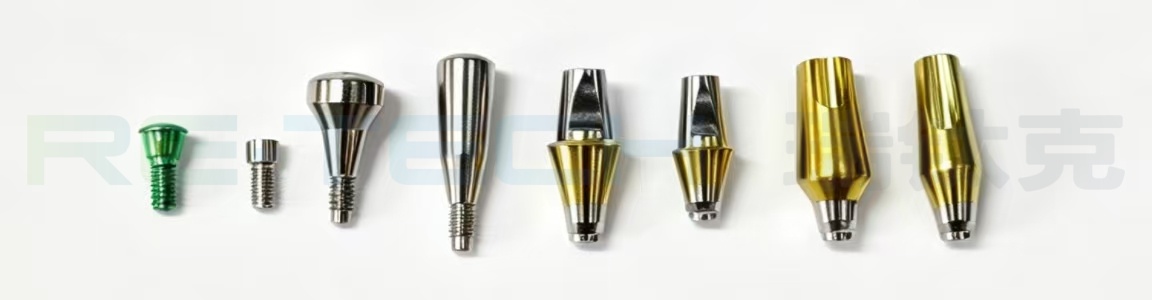
Four dominant abutment materials are widely adopted clinically: medical‑grade titanium alloy, zirconia, PEEK and titanium‑zirconia composite. Significant variations in biocompatibility, mechanical strength, translucency and wear resistance directly determine suitable clinical scenarios and restorative performance.
Made of medical Ti‑6Al‑4V ELI or pure titanium. It is the most well‑documented, stable and mechanically balanced abutment material in clinical use to date and the gold standard for posterior restorations.
Advantages: High tensile strength, exceptional fatigue and deformation resistance to withstand heavy masticatory force in posterior regions; outstanding biocompatibility, corrosion resistance, no metallic ion release and low risk of soft tissue inflammation; broad compatibility, cost efficiency and abundant long‑term clinical data.
Disadvantages: Dark metallic substrate tends to show through thin gingiva in anterior sites, causing grey shadowing and compromising premium esthetic outcomes.
Indications: All posterior restorations, multi‑unit splinted crowns, full‑arch rehabilitation, bruxism and high occlusal force cases. The dominant material for functional restorations.
Fully ceramic zirconia with natural tooth‑like color, good translucency, no metallic shadow and ultra‑smooth surface that resists plaque adhesion. The dedicated material for anterior esthetic restorations.
Advantages: Translucent natural shade completely eliminates gingival grey lines; smooth surface delivers favorable soft tissue compatibility and reduces gingival swelling and hyperplasia; esthetic quality surpasses metal abutments.
Disadvantages: Higher brittleness than titanium alloy, weaker impact and fatigue resistance. It cannot sustain extreme occlusal loading and is prone to chipping or fracture under prolonged heavy force.
Indications: Anterior single‑tooth esthetic restorations, patients with thin gingiva, cases demanding superior appearance and patients sensitive to oral hygiene. Not recommended for heavy posterior loading or full‑arch fixed bridge restorations.
A high‑performance polymer with flexible texture, elastic adaptation to soft tissue and no metallic irritation, mainly used for provisional transitional restoration and gingival contouring.
Advantages: Gentle on newly formed gingiva, freely millable and low cost, suitable for short‑term transitional wear.
Disadvantages: Low mechanical strength and prone to wear and deformation; unable to bear occlusal load for definitive restorations.
Indications: Provisional restoration for immediate implants, gingival contouring transition and postoperative soft tissue swelling phase. For short‑term use only; not for permanent loading.
Composite construction with titanium base and zirconia superstructure, combining core strengths of both materials. Currently the preferred premium clinical option.
Advantages: Titanium base guarantees tight interface fit and mechanical stability to prevent loosening and microleakage; zirconia upper section delivers premium esthetics without metallic show‑through, balancing strength and appearance.
Indications: High‑end anterior definitive restorations, thin‑gingiva esthetic cases and complex cases requiring both stability and outstanding appearance.
This standardized selection guide summarizes recommendations based on site, occlusal load, esthetic demand and gingival condition, covering 99% of clinical scenarios.
| Clinical Case Conditions | Recommended Abutment Type | Core Rationale for Selection |
| Routine posterior single‑tooth restoration | Standard titanium straight abutment | Sufficient strength, stable loading, cost‑effective for normal occlusion |
| Posterior angular deviation / insufficient bone volume | Titanium angled abutment | Corrects path of insertion, maintains normal occlusion and withstands heavy posterior occlusal load |
| Routine anterior esthetic restoration | Full zirconia abutment | Eliminates metallic grey show‑through with natural translucent tooth shade for superior esthetics |
| High‑end refined anterior restoration | Custom titanium‑zirconia composite abutment | Combines interface stability and premium esthetics for thin gingiva and high‑demand cases |
| Immediate implant provisional restoration | PEEK / provisional titanium abutment | Gentle material protects soft tissue for short‑term transitional wear |
| Multi‑unit splinted crown / full‑arch rehabilitation | High‑strength custom titanium abutment | Deformation and fatigue resistance to sustain balanced complex occlusal loading and deliver long‑term stability |
| Bruxism / patients with heavy occlusal force | Reinforced heavy‑duty titanium abutment | Enhanced structural strength to prevent loosening and deformation induced by chronic occlusal vibration |
Many restorative complications stem not from product defects but human errors from poor selection. The four misconceptions below are major contributors to clinical rework and long‑term failure.
Myth 1: Blind use of titanium abutments for anterior sitesUsing regular titanium abutments in thin‑gingiva anterior regions allows metallic background to shine through gingiva, creating grey discoloration over time and severely compromising esthetics — the most frequent avoidable error in anterior restoration.
Myth 2: Full zirconia abutments for heavy posterior loadingZirconia has relatively high brittleness and cannot endure persistent heavy masticatory force in posterior areas. Long‑term loading may trigger chipping, cracking or abutment fracture, shortening restoration lifespan significantly.
Myth 3: Using provisional abutments as definitive abutmentsPEEK and standard provisional abutments are not engineered for permanent loading. Long‑term placement causes deformation, marginal microleakage and screw loosening and must never be used for definitive restorations.
Myth 4: Matching interface means universal interchangeabilityAbutments with identical interface design still differ in material strength, transmucosal height and shoulder contour. Blind substitution leads to occlusal imbalance, gingival compression and compromised sealing, planting hidden long‑term risks.
Abutment categories are extensive. Strategic stocking achieves full clinical coverage while minimizing overstock, satisfying both clinic treatment and channel distribution demands.
Prioritize “full clinical coverage, low rework and standardization”. Maintain three core stock lines: standard straight titanium abutments, titanium angled abutments and healing abutments, covering 90% of basic cases. Keep limited inventory of zirconia and titanium‑zirconia composite abutments for esthetic cases. Rely on manufacturer custom fabrication for high‑end complex cases without bulk stocking.
Build a product portfolio combining high‑volume standard lines and differentiated premium offerings. Standard titanium abutments serve as core high‑turnover products securing baseline profit; zirconia esthetic abutments and titanium‑zirconia composite abutments create differentiated selling points to escape low‑price competition. Supplement with provisional and custom abutment services to meet one‑stop procurement demands and boost customer loyalty.

Q1: What is the primary difference between titanium and zirconia abutments?A: The core distinction lies in strength and esthetics. Titanium abutments feature high strength and stability for functional restorations; zirconia abutments offer translucent natural appearance without metallic shadow for esthetic restorations. They complement rather than replace one another.
Q2: Is zirconia abutment mandatory for anterior restorations?A: Not always. Titanium abutments can be adopted for anterior cases with thick gingiva and moderate esthetic expectations. Zirconia or titanium‑zirconia composite abutments are preferred for patients with thin gingiva seeking maximum esthetic outcomes.
Q3: How to choose between angled stock abutments and custom abutments?A: Prefabricated angled abutments are selected for mild angular deviation with high efficiency and cost benefits. Custom abutments are used for severe angular deviation and special gingival morphology in complex cases for superior fitting precision.
Q4: Can PEEK abutments be worn long‑term?A: No. PEEK is exclusively for short‑term transitional use. Insufficient mechanical strength causes deformation and fracture under prolonged loading and fails definitive restoration criteria.
Q5: How to reduce long‑term abutment‑related complications?A: Follow the principle of case‑specific precise selection: titanium alloy for high posterior strength requirements, zirconia for anterior esthetics and custom abutments for complex cases. Combine with proper occlusal adjustment and soft tissue adaptation to avoid loosening, microleakage and bone resorption at the source.
Though structurally simple, implant abutments are the core component determining success and long‑term clinical performance of implant restorations. Prefabricated abutments deliver efficient solutions for routine cases while custom abutments address complex challenging cases. Titanium alloy prioritizes load‑bearing stability; zirconia focuses on esthetic restoration; titanium‑zirconia composite material balances mechanical performance and aesthetics. Each type and material serves distinct purposes and should not be swapped arbitrarily.
For dental clinics, mastering abutment selection logic drastically reduces restoration rework, elevates esthetic quality, extends implant service life and mitigates doctor‑patient disputes. For dental distributors, clear segmentation of abutment categories, material advantages and clinical indications enables building professional, differentiated product portfolios to escape low‑price homogenized competition and deliver targeted clinical solutions for end customers.
Against the trend toward refined, esthetic and digital implant restoration, matching abutment specifications precisely to case requirements is critical to lifting clinical standards and strengthening core competitiveness in distribution channels.